Evergreen resource
The ADHD Toolkit
These are the actual, unglamorous tools I use every day — not a theory of productivity, just what holds up on an ordinary Tuesday. I add to this page as new things work. I quietly remove things that stop working.
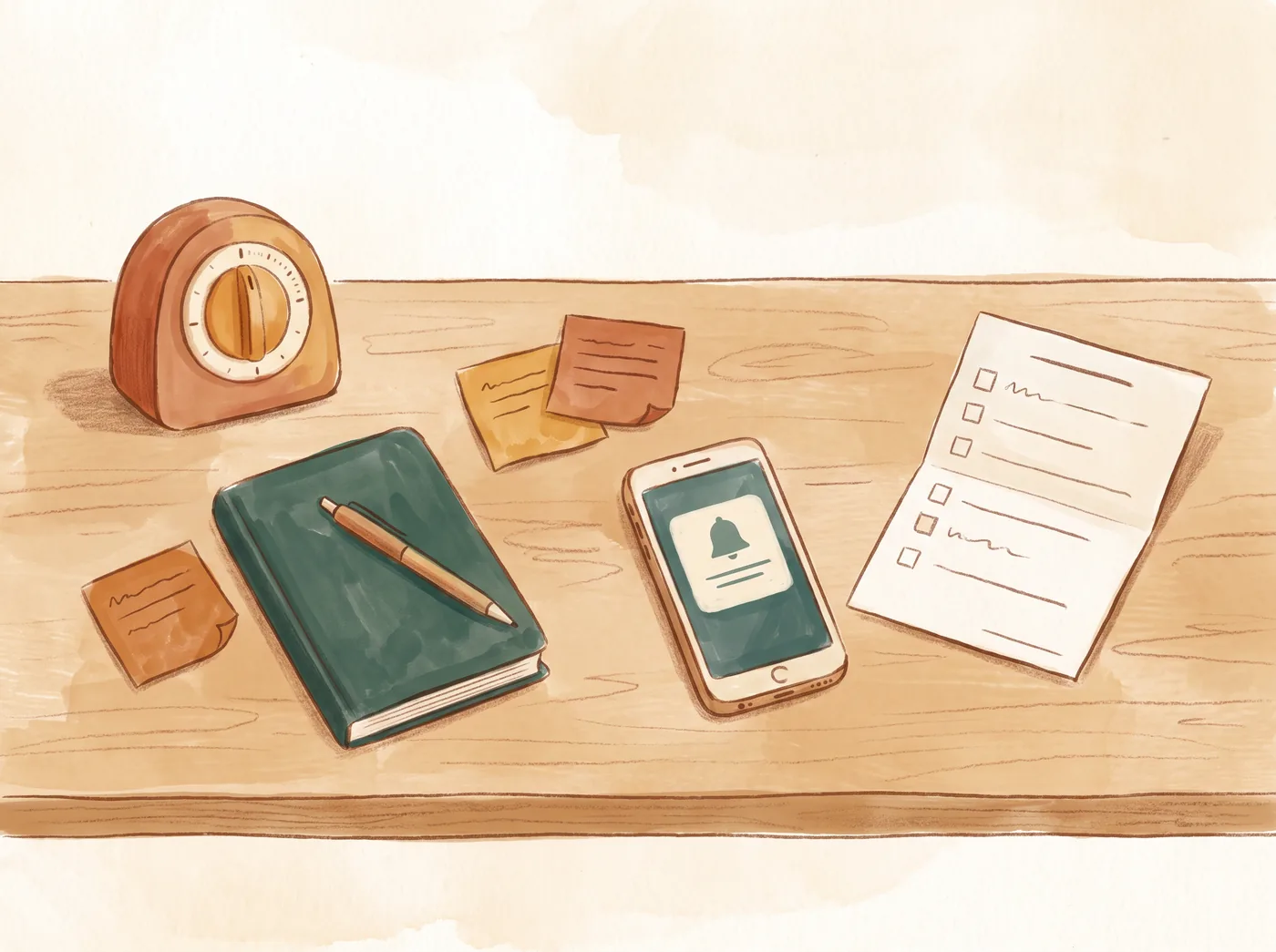
The 10-minute timer deal
When a task feels too big to start, I set a timer for 10 minutes and commit only to that. When it goes off, I'm genuinely allowed to stop — no guilt, no exceptions. That permission is the entire mechanism: my brain fights open-ended tasks but agrees to almost anything with a visible exit. Most of the time momentum carries me past the buzzer anyway.
Body doubling
A video call with a friend where we're both just quietly doing our own separate tasks, cameras on, barely talking. Something about another person's presence — even virtual, even silent — makes starting easier. I don't fully understand the mechanism. I just know it works and I've stopped being ashamed of needing it.
Habit-stacking on something automatic
New habits don't stick when they rely on memory alone. I attach them to something that already happens every day without fail — I open the mail while the kettle boils, because the kettle boils regardless of what my brain remembers. The existing habit becomes the reminder.
One landing spot per category
Mail goes in exactly one tray. Keys hang on exactly one hook. Removing the decision of "where does this go" removes a whole step my brain likes to bail on halfway through. Fewer choices, fewer chances to drop the thread.
Breaking tasks down absurdly small
"Clean the kitchen" is not a task, it's a paragraph. "Clear the counter" is a task. "Put three cups in the sink" is a task I can actually start. If I'm stuck, the task is still too big — I cut it in half again, and again, until the very first physical motion is obvious.
Naming the shame spiral out loud
When the voice starts — you're behind because you're lazy, you always do this — I say it out loud, sometimes to an empty room: "okay, shame spiral, I see you." Naming it breaks its disguise as truth. It's a pattern, not a verdict, and it loses some power the moment it's not a secret.
Restart with one piece, not the whole system
After a setback, the urge is to rebuild everything at once out of guilt — catch up on every app, every message, every habit, same afternoon. That always backfires for me. Instead I pick the single smallest piece of my routine and do only that until it feels normal again, then add the next piece.
External reminders over internal memory
I don't trust my memory to hold appointments, medication times, or follow-ups, and I've stopped treating that as a character flaw. Alarms, calendar pings, and a physical note by the door do the remembering so I don't have to rely on a brain that's already working hard elsewhere.
A written record instead of a mental one
I write one true sentence about most days, good or bad, close to when it happened. Recovery and ADHD both distort memory in the dramatic direction — the record keeps me honest about how things actually went, which is usually better than either version my brain wants to tell me.
Four honest words beat a perfect explanation
When I've gone quiet on people who care about me, I don't wait to have the perfect explanation ready. "Having a rough week" is enough to send. Waiting for eloquence just extends the silence, and the silence is what feeds the spiral.
Radical honesty in the program
Saying the actual thing to my counselor or in a meeting, even when it costs me — and correcting myself in the same breath if I catch myself softening the truth on the way out. The version that costs something is usually the one that's actually true.
The self-honesty gut check
Before I let a rationalization slide, I ask myself one question: would I be okay saying this out loud to my sponsor, right now, in these exact words? If the answer is no, that's the tell that I'm negotiating with myself instead of being straight.
Accountability means someone else sees the whole picture
I keep at least one person with standing permission to ask me anything and get a straight answer back. Secrecy did a lot of work for my addiction — refusing to let it do that job anymore is most of what accountability actually means for me.
Grounding through the body, not just the head
When my head starts spinning, I give my body a job instead: 5-4-3-2-1 senses, feet flat on the floor, or taking the dog out. It doesn't out-think the spiral — it just gives the rest of me somewhere to go while the spiral runs out of steam.
Making the phone I'm stuck in work for me
My phone habit isn't going anywhere, so I turned it into leverage instead of just a problem. Every bill due date, court date, and appointment goes straight into the calendar already built into my phone, with an alarm attached — so at least some of those dozens of daily pulls are the calendar catching something that matters, not another scroll.
Novelty sprinkles
Keep your core routines steady — the same timer trick, the same landing spots, the same order of operations. But if your brain craves variety, don't fight it head-on. Sprinkle novelty into the parts that don't matter: a different room to work in, a new playlist, warmer lighting instead of overheads. The routine itself doesn't move. Just the wrapper around it changes enough to keep your brain from getting bored and sabotaging the whole thing.
Map your triggers, then plan for them
Take the time to actually learn what sets you off — stress, boredom, big emotions, certain people or places — instead of figuring it out mid-crisis. For each trigger, decide ahead of time what your move is: a person to call, a place to go, a line to say out loud. A backup plan built in a calm moment holds up far better than anything you'd invent in the heat of it.
Find support that sees both sides
Work with a therapist or counselor who understands both ADHD and substance recovery, not just one or the other. The two feed each other more than most people realize — impulsivity, dopamine-seeking, shame spirals, executive dysfunction all show up in both. A provider who only sees the addiction half, or only the ADHD half, will miss the parts of you that connect them.
A simple starter plan for our brains
Try this for one week:
- Write 3 daily priorities.
- Set 2 or 3 alarms.
- Move your body for 10 to 20 minutes.
- Go to bed at the same time each night.
- Text one support person every day.
A separate section — learning, not labelling
NeuroDiversion
Neurodivergent is a broad, non-diagnostic word for people whose brains process, learn, regulate, feel, or experience the world differently from what is considered neurologically typical.
It is not a single diagnosis. It’s an umbrella term, and the umbrella is wide — it stretches across developmental, neurological, psychiatric, learning, sensory, trauma-related and other overlapping conditions. Some people are born under it, some arrive under it later, and plenty of people sit under more than one part of it at once.
This section is here for learning. It is meant to show what can fall under or around the broader umbrella often associated with ADHD and other related conditions. It is not here to tell you what you have, diagnose you, or sort people into neat boxes.
And overlap doesn’t mean sameness. Two things on this list can share a trait — trouble with focus, sensory overwhelm, big emotions that arrive late — and still be completely different conditions, with different causes, different day-to-day realities, and different kinds of support that actually help. Sitting near each other on a page says nothing about how alike they are, and nothing about the people living with them. I’m not a clinician, and none of this is medical advice.
A quiet check-in
This part is anonymous and completely voluntary. If something below feels familiar, you can tap it. That’s the whole thing. It isn’t a diagnosis, a claim, or a test result — it’s just a quiet way of saying “I know this one too,” and of showing the next person reading that they aren’t the only one.
No names, no comments, no accounts, no sign-ups, no tracking, and no public identity of any kind is collected — a number goes up, and that’s all. One tap per entry, per device. You can skip all of it and just read; nothing here changes either way.
-
ADHD
A difference in attention, impulse control and motivation, where focus can swing between scattered and completely locked-in depending on interest, urgency or stress.
-
Autism
A difference in how someone communicates, reads social situations, processes sensory input, and relates to routine and change.
-
Dyslexia
A learning difference that mainly affects reading, spelling and how quickly written words get decoded — separate from intelligence or effort.
-
Dysgraphia
A learning difference affecting handwriting and getting thoughts onto the page, so writing costs far more effort than it looks like it should.
-
Dyscalculia
A learning difference affecting numbers — quantity, sequence, mental arithmetic, and estimating things like time or amounts.
-
Sensory Processing Disorder
Difficulty organising everyday sensory input, so sound, light, touch or texture can land as overwhelming, muted, or both at different times.
-
OCD
Unwanted, distressing intrusive thoughts paired with compulsions — mental or physical acts a person feels driven to repeat to get relief.
-
Bipolar disorder
A mood condition involving episodes of raised or agitated energy and episodes of depression, each lasting longer and going further than an ordinary mood swing.
-
PTSD
A stress condition that can follow a traumatic event, with intrusive memories, a nervous system stuck on alert, and avoidance long after the danger has passed.
-
CPTSD
A related pattern linked to prolonged or repeated trauma, often carrying the PTSD features plus lasting difficulty with self-worth, emotional regulation and closeness.
-
DID
A dissociative condition, usually linked to severe early trauma, where identity and memory are held across distinct parts rather than experienced as one continuous self.
-
OSDD
A dissociative condition in the same family as DID, where the separation between parts or the gaps in memory don’t match the DID description exactly.
-
Epilepsy
A neurological condition involving recurring seizures caused by bursts of unusual electrical activity in the brain.
-
Acquired Brain Injury (ABI)
Any brain injury that happens after birth — from an accident, a stroke, an illness or a loss of oxygen — which can change memory, attention, mood or coordination.
-
Tic disorders
Conditions involving involuntary movements or sounds that build as pressure and are hard or impossible to hold back for long; Tourette’s is one of them.
-
Schizophrenia
A condition that can involve changes in perception and belief, such as hearing or seeing things other people don’t, alongside changes in thinking, motivation and energy.
-
ASPD
A personality condition described as a long-running pattern of disregard for rules and for other people’s rights, often with impulsivity and difficulty feeling remorse.
-
BPD
A personality condition involving intense emotions that shift fast, an unsteady sense of self, and a deep fear of being abandoned inside close relationships.
-
NPD
A personality condition involving a fragile sense of self propped up by a need for admiration, often alongside difficulty recognising other people’s feelings.
-
HPD
A personality condition involving a strong, ongoing need for attention and approval, with emotion expressed in a dramatic or heightened way.
-
Down syndrome
A genetic condition present from birth, caused by an extra copy of chromosome 21, which affects development, learning and some areas of physical health.
-
Misophonia
A strong, involuntary distress or anger response to specific repeated sounds, like chewing, tapping or breathing.
-
Synesthesia
A blending of the senses where one kind of input reliably triggers another, like seeing colours for letters, numbers or music.
Don’t see yourself in the list? You can still be counted here.
This isn’t a diagnosis either, and it isn’t part of the list above. It’s just room for the experiences that don’t have a tidy name on this page — including the one that started this whole blog for me.
Same as above: one tap per device, anonymous, no names and no comments — just a number.
Autism + ADHD, together
Signs of AuDHD
AuDHD isn’t a diagnosis on paper for me — it’s just the word that finally made a lot of this make sense. I’m not a clinician and this isn’t a checklist for anyone else to self-diagnose from. It’s just the pattern, laid out plainly, in case you read it and feel less alone the way I did.
Want the small wins that come from using these?
Read the journal for the day-to-day version of these tools actually being used — including the days they don't work.
Read the journal →